

If you’re a fresher or student looking at the IT industry, it’s normal to feel confused. One person says “learn AI,” another says “full stack is dead,” and social media keeps pushing overnight success stories.
The reality is simple: Career Growth in IT does not happen through trends. It happens through clarity, skills, proof of work, and consistency.
At Vatsal Technosoft – an IT Consulting & Services Company, under the leadership of Founder & Managing Director – Vatsal Shah, thousands of freshers have followed a steady, ethical growth path. This article shares that real-world roadmap.
This guide is written for:
- IT freshers
- College students
- Early-career professionals
No hype. No salary promises. Only a clear IT career path you can trust.
Why freshers feel confused

Freshers are not confused because they lack ability. They are confused because the IT industry shows too many options without context.
Common reasons include:
- Too many roles with unclear differences
- Conflicting advice from online creators
- Fear of choosing the “wrong” domain
- Pressure from peers and relatives
- College learning not matching industry work
The biggest mistake freshers make is asking:
“Which IT field has the highest future?”
The better question is:
“Which IT skill can I practice daily and improve every week?”
That shift alone brings clarity in Career Growth in IT.
Skills vs degree – industry reality

A degree helps you enter the IT industry. Skills help you grow in it.
What a degree actually provides
- Eligibility for fresher roles
- Basic technical foundation
- Initial credibility
What skills actually provide
- Ability to complete tasks
- Confidence in interviews
- Faster learning on the job
- Long-term career stability
Industry truth:
Most IT companies hire freshers for potential, but they promote professionals based on delivery and reliability.
The smartest approach for IT careers for freshers:
- Use your degree to get interviews
- Use skills and projects to stand out
- Use discipline and communication to grow
Most industry expectations align with global learning standards published by platforms like MDN Web Docs and GitHub Docs, which emphasize fundamentals, version control, and practical implementation over theory alone.
Career Growth in IT improves when skills and education work together, not against each other.
How IT companies evaluate freshers

Ethical IT companies do not expect freshers to know everything. They check whether you are trainable and dependable.
Key evaluation areas
1. Fundamentals
- Programming basics
- Logical thinking
- Database basics (especially SQL)
2. Proof of work
- Small but complete projects
- Clear GitHub repositories
- Documentation explaining your work
3. Communication
- Can you explain what you built?
- Can you describe how you solved problems?
4. Attitude
- Willingness to learn
- Consistency
- Accountability
Two freshers with the same degree will not be treated equally if only one can show real work.
That’s why Career Growth in IT starts with building visible proof, not certificates.
Realistic IT Career Paths for Career Growth in IT

Freshers often believe they must choose the perfect role immediately. In reality, most IT careers evolve gradually.
Common IT career paths for freshers
1. Software Developer
- Start with one language
- Learn Git and APIs
- Build small working applications
2. QA / Testing
- Manual testing fundamentals
- Bug reporting
- Automation basics later
3. Data Analyst
- Excel or Sheets
- SQL fundamentals
- Basic dashboards
4. Cloud / DevOps
- Linux and networking basics
- CI/CD concepts
- Cloud fundamentals
5. Cybersecurity
- Networking basics
- Security fundamentals
- Vulnerability awareness
6. UI/UX Design
- Design thinking
- Figma basics
- User-focused problem solving
Your IT career path becomes clearer once you start doing, not just choosing.
Freshers exploring security roles should also understand common vulnerabilities listed by the OWASP Top 10, which is widely referenced by IT companies worldwide.
These steps directly support Career Growth in IT by building consistency, confidence, and real-world exposure.
Common fresher mistakes

Mistakes slow down Career Growth in IT, but they are avoidable.
Most common mistakes
- Learning many tools but finishing nothing
- Watching tutorials without building
- Ignoring basics like SQL and logic
- Weak resumes with no real projects
- Comparing timelines with others
The fastest-growing freshers focus on:
- One skill at a time
- One project at a time
- Continuous improvement
Consistency beats motivation every time.
How ethical organizations support growth

Not every IT company supports growth the same way.
Ethical organizations focus on:
- Structured onboarding
- Clear role expectations
- Skill-based evaluation
- Mentorship and feedback
- Professional work culture
At companies like Vatsal Technosoft, fresher growth is not rushed. It is planned, measured, and supported.
A fresher who improves slightly every month becomes far more valuable than someone chasing shortcuts.
That’s how long-term IT careers for freshers are built.
A simple 8-week roadmap for Career Growth in IT
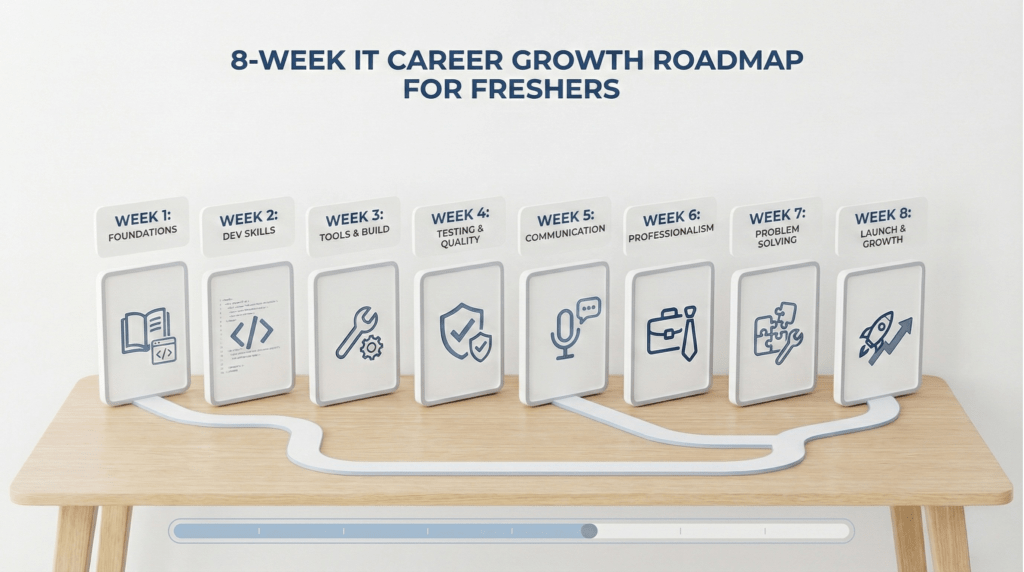
Week 1–2: Choose one IT path + basics
Week 3–4: Build one complete project
Week 5–6: Improve project + documentation
Week 7: Resume and interview preparation
Week 8: Apply, review feedback, improve
This roadmap alone can put you ahead of most freshers.
FAQ: Career Growth in IT
What is the best Career Growth in IT strategy for freshers?
Focus on one role, build 2–3 real projects, strengthen fundamentals, and practice explaining your work clearly.
How do I choose an IT career path?
Choose the path you can practice daily without burnout. Try one direction for two weeks before switching.
Do IT companies hire freshers without experience?
Yes, if you show learning ability, discipline, and proof of work.
How many projects are enough?
Two to three well-documented projects are enough for most fresher roles.
This approach ensures sustainable Career Growth in IT without burnout or confusion.

Leave a Reply